
- 16/11/2026
- by Dr. Ketaki Gudadhe-Shinde
- Blog
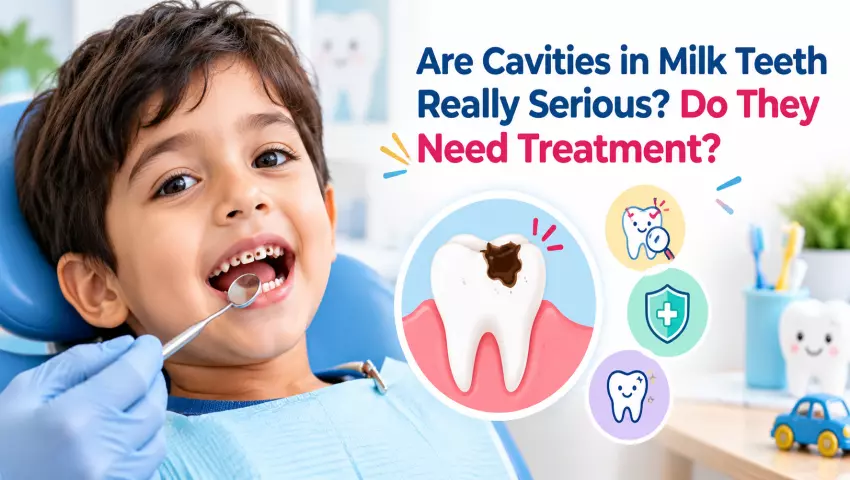
Are cavities in milk teeth really serious? Many parents say, “It is only a milk tooth. It will fall anyway, so why treat it?” We hear this almost every day in our clinic. The honest answer is: yes, cavities in milk teeth are serious, and they need treatment.
If you are looking for the Best Pediatric Dentist in Wakad, you are in the right place. Dr. Ketaki Gudadhe-Shinde has 7+ years of experience. Her areas of expertise include root canal treatments, post-endodontic therapy (posts, crowns, and bridge work), aesthetic procedures (smile design, laminates, veneers, dental bleaching, diastema closures, etc.) and orthodontic treatments. She is a member of the Indian Society of Pedodontics and Preventive Dentistry (ISPPD).
In this blog, we explain in simple words why a milk teeth with cavity should never be ignored, what signs to look for, and how a Pediatric Dental Clinic in Wakad can help your child stay pain-free.
Why Do Parents Ignore Cavities in Baby Teeth?
Most parents are not careless. They simply believe a few common myths:
- “Milk teeth fall anyway.” True, but they fall at different ages. Some back teeth stay until 11 or 12 years. A child cannot live with pain and infection for so many years.
- “My child is not complaining, so it is fine.” Small children often cannot explain pain. They just eat less, become cranky or avoid hard food.
- “The new teeth will be healthy anyway.” Not always. An infection in a milk tooth can harm the permanent tooth growing right below it.
Once you understand this, you will see why early care matters.
Are Cavities in Milk Teeth Really Serious? Yes, Here’s Why
Cavities in milk teeth can create many problems, not just a hole in the tooth.
- Pain and trouble in eating: A deep cavity can hurt while eating, drinking cold water or even at night. Children may start refusing meals, which affects their nutrition and growth.
- Infection and swelling: When a cavity reaches the nerve, it can cause an abscess. You may see swelling on the gum or face, a small pimple-like boil on the gum, or pus.
- Damage to permanent teeth: Permanent tooth buds sit just under the milk teeth. A serious infection can leave marks, spots or weak enamel on the new tooth.
- Early tooth loss: If a milk tooth is lost too early, nearby teeth move into the empty space. Later, the permanent tooth may not get enough room, and your child may need braces.
- Speech and chewing problems: Missing front teeth can affect how a child pronounces some words. Missing back teeth make chewing difficult.
- Poor sleep, school absence and low confidence: Toothache disturbs sleep and school routine. Children with visible black teeth may also feel shy to smile.
- Cavities spread fast: Milk tooth enamel is much thinner than permanent tooth enamel. So a small cavity can become a deep one in just a few months.
How to Know if Your Child Has a Cavity?
Look for these signs at home:
- White, chalky patches near the gum line (this is the earliest sign)
- Brown or black spots on teeth
- Small holes or pits
- Food getting stuck between teeth again and again
- Sensitivity to cold, hot or sweet things
- Bad breath that does not go away
- Red or swollen gums
- Child complaining of pain at night or refusing to eat
Simple home check: In good light, gently lift your child’s lip and look at the front and back of all teeth. Check the chewing surface of the back teeth too, as cavities often start there. If you see anything unusual, do not wait for pain. Visit a Kids Dentist in Wakad as soon as possible.
What Causes Cavities in Children?
Cavities in milk teeth usually come from daily habits:
- Frequent sugary snacks: chocolates, toffees, biscuits, packaged snacks, cold drinks and packed juices
- Bottle feeding at night: sleeping with a milk bottle in the mouth (this is called bottle caries)
- Poor brushing: especially skipping brushing at night
- Sticky foods: chips, candies and gummies stay on teeth for a long time
- Low use of fluoride: fluoride makes enamel stronger
- Family habits: children copy what parents do, and cavity-causing bacteria can also pass through shared spoons or kisses
The problem is not only how much sugar a child eats, but how often. Eating sweets again and again through the day gives bacteria more time to attack the teeth.
At What Age Can Cavities Start?
Cavities can start as soon as the first tooth comes out, usually around 6 months of age.
- 1 year: Night-time bottle feeding is the main risk.
- 2 to 3 years: Sweet snacks and weak brushing habits cause most problems. Yes, a 2-year-old or 3-year-old can definitely get cavities.
- 4 to 6 years: Back teeth get cavities easily because of food stuck in the deep grooves.
This is why dentists suggest the first dental visit by the child’s first birthday.
Do All Milk Teeth Cavities Need Treatment?
The treatment depends on how deep the cavity is.
- Very early stage (white spots): Can often be stopped with fluoride application, better brushing and diet changes.
- Small to medium cavity: Needs a filling.
- Deep cavity near the nerve: Needs a pulpectomy or pulpotomy (often called a baby root canal) and usually a crown.
- Severely damaged tooth: May need extraction, followed by a space maintainer.
Waiting only makes treatment harder, longer and costlier. A cavity found early may need just a quick filling. The same cavity left for six months may need a root canal and crown.
Treatment Options for Cavities in Milk Teeth:
Here is a simple explanation of each option:
- Fluoride application: A painless gel or varnish is painted on the teeth. It strengthens enamel and helps stop early cavities.
- Tooth-coloured fillings: The decayed part is cleaned and the tooth is filled with a material that matches the colour of the tooth.
- Pulpectomy or pulpotomy (baby root canal): When infection reaches the nerve, the infected part is cleaned and the tooth is saved instead of removing it. This keeps the tooth in place till its natural time.
- Crowns (stainless steel or zirconia): After a root canal or a large filling, a crown covers and protects the weak tooth. Zirconia crowns are tooth-coloured and look natural.
- Extraction and space maintainer: If a tooth cannot be saved, it is removed. A small space maintainer keeps the gap open for the permanent tooth.
Will Treatment Hurt My Child? Is It Safe?
This is the biggest worry for most parents, and it is a fair one. A good Pediatric Dental Clinic in Wakad focuses on making the visit calm and comfortable.
- Numbing gel is applied first, so the injection is barely felt
- Local anaesthesia makes the tooth fully numb during treatment
- A gentle, child-friendly way of talking helps children feel safe
- Behaviour management techniques help nervous children relax
- Options are available for very anxious children, and these are discussed with parents first
- Most visits take around 20 to 45 minutes, depending on the treatment
With an experienced pediatric dentist like Dr. Ketaki Gudadhe-Shinde, children learn that the dentist is a friend, not something to fear. A good first experience helps build a lifelong habit of regular dental care.
What Happens If Cavities Are Not Treated?
Here is a simple timeline of what can happen:
- A small white or brown spot appears
- The spot becomes a hole and food gets stuck
- Pain starts, especially while eating or at night
- Infection reaches the nerve and the gum swells
- The tooth may need to be removed early
- The permanent tooth may come out crooked, weak or with marks
Every step can be avoided with early treatment.
How to Prevent Cavities in Milk Teeth?
The good news is that most cavities can be prevented with simple habits:
- Brush twice a day, especially at night before sleeping
- Use fluoride toothpaste: a rice-grain size for children below 3 years, and a pea size for children aged 3 to 6 years
- Help your child brush until about 7 to 8 years of age, as young children cannot clean properly on their own
- Stop night-time bottle feeds once your child is old enough, and never let a child sleep with a milk bottle
- Limit sugary snacks to meal times instead of all-day snacking
- Rinse the mouth with water after eating sweets or chocolates
- Visit the dentist every 6 months for check-ups and fluoride application
- Ask about sealants, a thin protective coating for the deep grooves of back teeth
When Should You See a Pediatric Dentist?
Book a visit if you notice any of these:
- Black, brown or white spots on teeth
- A visible hole in a tooth
- Toothache or sensitivity
- Swollen gums or a pimple on the gum
- Bad breath that does not go away
- Your child refusing food or waking up at night with pain
Even if there are no problems, the first dental visit should be by the age of 1 year. Do not wait for pain. By the time a child complains, the cavity is usually already deep.
Frequently Asked Questions:
Yes. A cavity does not heal on its own, and it keeps growing. A filling stops the decay and protects the tooth.
Only the very early white spot stage can be controlled with fluoride and good care. Once there is a hole, treatment is needed.
No. Leaving it can lead to pain, infection and early tooth loss.
Yes. A deep infection can affect the permanent tooth bud growing below it.
As soon as it is found, at any age. There is no need to wait for the child to grow older.
The cost depends on the type of treatment, such as a filling, root canal, crown or extraction. Visit the clinic for an exact estimate after checking the tooth.
If the cavity has reached the nerve, a baby root canal (pulpectomy or pulpotomy) can save the tooth and avoid early extraction.
Yes. Cavities can start as soon as teeth appear, so early care is important.
Rinse the mouth with lukewarm water and gently remove any stuck food with floss. Do not put any medicine or home remedy on the tooth. Please see a dentist the next day, because pain is a sign that treatment is needed.
Black or brown spots are often early or advanced cavities. They can also be stains, so it is best to get them checked by a dentist.
Looking for a Dentist in Wakad? Visit Kiddie Dental Home
If you are searching for a Dentist in Wakad who understands children, Kiddie Dental Home is here to help. Our clinic is a friendly, comfortable space for kids, where parents also get clear guidance on how to look after their child’s teeth.
Dr. Ketaki Gudadhe-Shinde treats children with care and patience, from simple check-ups and fillings to root canal treatments and crowns. Families from Wakad, Hinjewadi and Pimpri-Chinchwad trust us for gentle, honest dental care.
If you think your child has a milk teeth with cavity, please do not wait. Early treatment is quicker, easier and much more comfortable for your child.
Book an Appointment:
Take the first step towards healthy teeth and a happy smile for your child. Book an appointment with Dr. Ketaki Gudadhe-Shinde at Kiddie Dental Home, the Best Pediatric Dentist in Wakad.