
- 07/10/2026
- by Kiddie Dental Home
- Blog
Losing a tooth is more common than most people think, and it can happen at any age, due to decay, injury or gum problems. When this happens, replacing the tooth on time is important, not just for your smile, but also for how you chew, speak and keep your other teeth healthy.
When considering Dental Bridges vs. Implants, one question we hear very often At Kiddie Dental Home, a trusted Dentist in Wakad, one question we hear very often is, “Should I go for a dental bridge or a dental implant?” Both options work well, but they are quite different from each other. Our clinic is led by Dr. Ketaki Gudadhe-Shinde, with more than 7+ years of experience in general and family dentistry, and in this blog, she explains both options in simple words, so you can make the right choice for your smile.
Why Replacing a Missing Tooth Matters?
Many people ignore a missing tooth, especially if it is at the back of the mouth and not visible while smiling. But leaving a gap for too long can cause other problems, such as:
- Nearby teeth slowly shifting into the space
- Your bite becoming uneven, putting extra pressure on other teeth
- Bone loss in the jaw where the tooth is missing
- Difficulty chewing food properly
- Changes in your facial shape over time, in case of multiple missing teeth
This is why dentists usually recommend replacing a missing tooth as soon as possible, using either a bridge or an implant.
What Is a Dental Bridge?
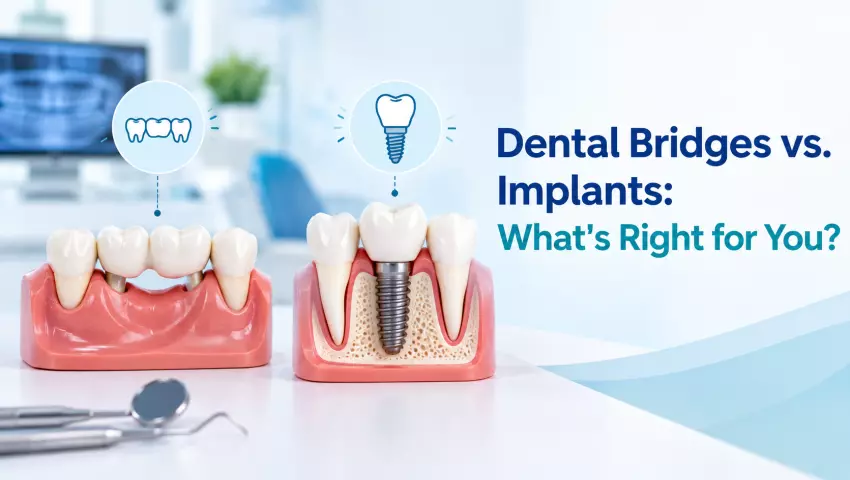
Let’s start with what is bridges in dental treatment. A dental bridge is a fixed, false tooth that fills the gap left by a missing tooth. It is called a “bridge” because it literally bridges the space between two teeth, using the teeth on either side as support.
To understand what is bridge in dental treatment more simply — the two teeth next to the gap are shaped slightly and covered with crowns, and a false tooth is fixed in between them. This is different from a removable option, since a bridge of teeth stays fixed in your mouth and is not taken out for cleaning.
Dental bridges are usually made from materials like porcelain or ceramic, so they blend in naturally with your other teeth. They work best when:
- Only one or a few teeth are missing in a row
- The teeth next to the gap are healthy and strong enough to support a crown
What Are Dental Implants?
Now let’s look at what are dental implants. Unlike a bridge, a dental implant does not depend on your neighbouring teeth at all. Instead, a small titanium post is placed directly into the jawbone, acting like an artificial tooth root. Over the next few months, the bone naturally grows around this post and holds it firmly in place. Once this is done, a crown is fixed on top, giving you a tooth that looks, feels and functions much like a natural one.
Dental implants are a good option when:
- You have one or more missing teeth, even if they are not next to each other
- Your jawbone is healthy enough to support the implant
- You are looking for a long-term, permanent-feeling solution
Dental Bridge: Pros and Cons
Here’s a simple breakdown to help you understand a dental bridge better:
Pros:
- Lower upfront cost compared to implants
- No surgery involved
- Usually completed in just two dental visits, spread over a couple of weeks
- Often better covered by dental insurance
Cons:
- Does not stop bone loss in the area of the missing tooth
- The neighbouring teeth need to be shaped down, even if they were healthy
- May need to be replaced after several years
- Slightly higher risk of decay in the supporting teeth if not cleaned properly
So, is a dental bridge permanent? Not exactly. While it stays fixed in your mouth and is not removable, it is not meant to last forever. On average, how long does a dental bridge last depends on how well it is cared for, but with regular brushing, flossing and dental check-ups, a good quality bridge can last for many years.
Dental Implants Bridge Combination and Implants: Pros and Cons
Sometimes, dentists also use a dental implants bridge combination, where a bridge is supported by implants instead of natural teeth. This is especially useful when several teeth are missing in a row and the natural teeth around them are not strong enough to support a regular bridge. When we talk about dental implants and bridges together, this combination often provides the strength of implants along with the coverage of a bridge, in cases where a full set of individual implants may not be necessary.
Pros of implants:
- Long-lasting, often for many years with proper care
- Helps prevent bone loss in the jaw
- Does not affect the health of neighbouring teeth
- Looks and feels very close to a natural tooth
Cons of implants:
- Higher upfront cost compared to a bridge
- Requires a minor surgical procedure
- Takes a longer time overall, since the bone needs time to heal around the implant
- May not be suitable for people with certain health conditions that slow down healing
A common concern parents and patients both ask us is, do dental implants hurt, or are dental implants painful? The procedure is done under local anaesthesia, so patients usually do not feel pain during the placement. Mild discomfort or swelling for a few days afterward is normal and can be easily managed with the medication your dentist prescribes.
Dental Implant Cost and Dental Bridge Cost: What to Expect?
One of the biggest questions patients have is about dental implant cost in India and dental bridge cost. It is important to know that the exact cost of dental implants or a bridge can vary quite a bit, depending on factors like:
- The material used for the crown or bridge
- Whether a single tooth or multiple teeth need replacement
- Whether bone grafting is required before placing an implant
- The clinic and the city you are getting treatment in
In general, a dental bridge tends to be more affordable upfront compared to an implant, while an implant, though costlier initially, often works out to be a longer-lasting investment since it does not need frequent replacement. Since what is the cost of dental implants can differ from patient to patient, it is best to get a personal consultation and quote based on your specific case, rather than relying only on general estimates.
Procedure and Timeline: What to Expect?
Dental Bridge:
- The dentist prepares the two teeth next to the gap by shaping them slightly.
- An impression is taken to create a custom bridge.
- A temporary bridge may be placed while your permanent one is made.
- The final bridge is fitted and adjusted for a comfortable bite.
This entire process is usually completed within a couple of visits, over one to two weeks.
Dental Implant:
- The implant post is surgically placed into the jawbone.
- A healing period follows, usually a few months, allowing the bone to fuse with the implant.
- Once healed, an abutment (connector piece) is attached.
- A custom crown is placed on top to complete the tooth.
Since how long does a dental bridge take is much shorter compared to implants, some patients prefer bridges simply for convenience, while others are happy to wait longer for the implant’s long-term benefits.
Are Dental Bridges or Implants Painful?
Many patients ask us, are dental bridges painful? Getting a bridge is generally a comfortable procedure, since it does not involve surgery. You may feel mild sensitivity in the days after your teeth are shaped, but this usually settles quickly.
Implants, being a surgical procedure, involve local anaesthesia during placement, and some manageable discomfort during the healing period, similar to what you’d expect after a tooth extraction.
How to Decide? Key Factors to Consider
Choosing between a bridge and an implant depends on your specific situation. Here are the main things to think about:
- Number of missing teeth: A bridge works well for one or a few teeth in a row. Implants offer more flexibility, especially for teeth that are not next to each other.
- Health of neighbouring teeth: If your natural teeth beside the gap are healthy, a dentist may still prefer keeping them untouched, which favours an implant.
- Jawbone health: Implants need enough bone to support them. In some cases, a bone graft may be suggested before implant placement.
- Overall health: Conditions that slow down healing may make implants less suitable, in which case a bridge could be the better option.
- Budget and timeline: If you need a faster and more affordable fix, a bridge may suit you better. If you’re looking for a long-term solution and can wait a bit longer, an implant may be worth it.
Your dentist can guide you after a proper examination, so it’s always best to discuss your specific case rather than deciding on your own.
Other Tooth Replacement Options Worth Knowing:
Bridges and implants are the most common choices, but they are not the only ones. Depending on your case, your dentist may also suggest:
- Partial dentures: A removable option that fills the gap, usually more affordable but less stable than a fixed bridge or implant
- Space maintainers: Mainly used as a temporary option, especially in children, to hold space until a permanent solution is planned
If you are also looking after your child’s dental health, our Pediatric Dental Clinic in Wakad at Kiddie Dental Home offers gentle, age-appropriate care for kids, including guidance on space maintainers when needed.
Frequently Asked Questions:
With good care, a dental bridge can last for many years, while dental implants often last even longer, sometimes for decades, since they are anchored directly into the jawbone.
A bridge does not involve surgery and is generally more comfortable to get. An implant involves a minor surgical procedure, so some discomfort during healing is normal, though it is well managed with proper care.
Yes. Bridges work well when the missing teeth are next to each other. For multiple gaps in different areas, implants, or a combination of dental implants and bridges, may be recommended.
This depends on your specific insurance policy. Bridges are more commonly covered, while implant coverage varies, so it’s best to check directly with your insurance provider.
Over time, nearby teeth can shift, your bite can become uneven, and bone loss can occur in the empty space, which can lead to more complex dental issues later.
While implants have a high success rate, factors like poor bone health, smoking or uncontrolled medical conditions can occasionally affect healing. Your dentist will assess your suitability before recommending an implant.
Conclusion:
Both dental bridges and dental implants are effective ways to replace a missing tooth, and there isn’t one single “better” option for everyone. A bridge may suit you if you’re looking for a quicker, more affordable fix, while an implant may be worth considering if you want a long-term solution that also protects your jawbone.
The right choice really depends on your specific dental health, budget and long-term goals, which is best discussed with a qualified Pediatric dentist in wakad. Dr. Ketaki Gudadhe-Shinde and the team at Kiddie Dental Home are happy to guide you through this decision with a proper examination and honest advice. Whether you are exploring dental implant in Wakad options or considering a dental bridge treatment in Wakad, you can book a consultation through Kiddie Dental Home and take the next step towards restoring your smile with confidence.