- 24/11/2026
- by Dr. Ketaki Gudadhe-Shinde
- Blog
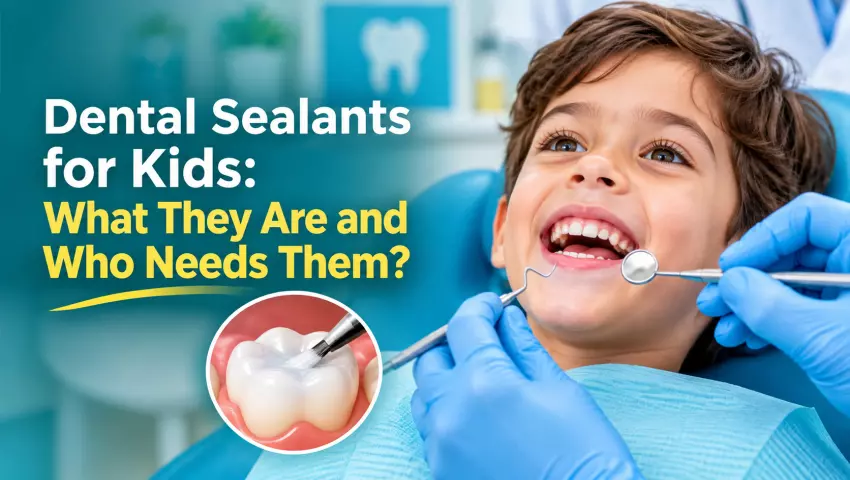
Dental sealants are a thin, clear or tooth-coloured coating painted on the chewing surface of the back teeth. They fill the deep grooves where food and germs get stuck, so cavities are much less likely. They are best for children with newly erupted permanent molars (around 6 to 7 years and 11 to 13 years) and for kids who get cavities easily. The treatment is quick and painless, usually without any injection or drilling.
Dental sealants for kids are one of the simplest ways to protect back teeth from cavities. Many parents tell us, “My child brushes every day, but still gets cavities in the back teeth. What else can I do?” At Kiddie Dental Home, a trusted Pediatric Dental Clinic in Wakad, this is one of the questions we hear most often, and sealants are often a big part of the answer.
If you are looking for the Best Pediatric Dentist in Wakad, you are in the right place. Dr. Ketaki Gudadhe-Shinde has 7+ years of experience. Her areas of expertise include root canal treatments, post-endodontic therapy (posts, crowns, and bridge work), aesthetic procedures (smile design, laminates, veneers, dental bleaching, diastema closures, etc.) and orthodontic treatments. She is a member of the Indian Society of Pedodontics and Preventive Dentistry (ISPPD).
In this blog, we explain what dental sealants are, who needs them, at what age to get them, whether they are safe, and what they cost, all in simple words.
What Is a Sealant? Dental Sealants for Kids Explained
Parents often search for terms like sealants teeth, sealants tooth or what is sealant. All of them mean the same thing. A dental sealant is a thin protective layer, like a raincoat, that a dentist paints on the chewing surface of a tooth. It is usually made of a resin material or a glass ionomer material, and it is clear, white or tooth-coloured, so it is hardly noticeable.
Sealants are placed mostly on sealants for molars, which are the big back teeth, and sometimes on premolars. These teeth do most of the chewing and have the deepest grooves.
Why Are Back Teeth So Prone to Cavities?
Look at the chewing surface of a molar. It is not flat. It has deep pits and grooves, and many of them are narrower than a single toothbrush bristle. This is why:
- Food and sugar get trapped in the grooves after eating
- Germs stay there and make acid that slowly breaks down the enamel
- New teeth are weaker. The enamel of a freshly erupted permanent tooth is still maturing
- Brushing alone cannot reach the bottom of deep grooves, especially in young children
That is why cavities in children so often start on the back teeth, even when parents are careful. Tooth decay in kids is common, but a large part of it can be prevented.
Who Needs Dental Sealants?
Sealants are useful for:
- Children with newly erupted permanent molars
- Kids with deep grooves on their back teeth
- Children who have already had cavities earlier
- Kids who often eat sweets, chocolates, biscuits and packaged snacks
- Children who find it hard to brush well, for example very young children
- Kids who do not get enough fluoride
Not every child needs them. If the grooves are shallow and the child has a low risk of cavities, the dentist may simply advise regular check-ups. A sealants dentist, meaning a dentist who places dental sealants regularly, can tell you what your child needs after a proper check-up.
At What Age Should Kids Get Dental Sealants?
The best time is soon after the permanent tooth comes out, before cavities have a chance to start.
- First permanent molars: around 6 to 7 years of age
- Second permanent molars: around 11 to 13 years of age
- Premolars: when the grooves are deep
- Milk molars: sometimes, for very high-risk children, after the dentist’s advice
Many parents do not notice the first permanent molar coming out, because it appears behind the last milk tooth without any milk tooth falling first. A check-up around age 6 is a good habit.
Are Dental Sealants Safe for Children?
Yes. Dental sealants have been used for many years, and dental associations consider them safe when they are placed by a dentist.
Some parents worry about the material, especially a chemical called BPA. The amount of exposure from a sealant is very small. Your dentist will choose the right material for your child. If your child has any allergy, please tell the dentist before the treatment.
How Are Dental Sealants Applied? Step by Step
Placing sealants on molars is quick and simple. For each tooth, it usually takes only a few minutes.
- Check-up and cleaning. The tooth is cleaned so that the surface is free of plaque and food
- Drying. The tooth is dried and kept away from saliva
- Preparing the surface. A gentle gel is applied so that the sealant sticks well
- Applying the sealant. The sealant is painted on the grooves
- Hardening. A special light sets the sealant in a few seconds
- Final check. The bite is checked to make sure it feels comfortable
At Kiddie Dental Home, Dr. Ketaki Gudadhe-Shinde explains each step to the child before starting, in simple and friendly words, so that children know exactly what to expect.
Does Getting Sealants Hurt?
No. Getting sealants is painless. There is no drilling, and in most cases no injection is needed, because the tooth is not being cut. Your child may only feel the tooth being dried and a little pressure.
Some children feel nervous about any dental visit. Dr. Ketaki Gudadhe-Shinde uses a calm, step-by-step approach: she shows the tools, explains what will happen and lets the child get comfortable first. After the treatment, the bite may feel slightly different for a day or two, and then your child gets used to it.
How Long Do Dental Sealants Last?
With good care, many sealants last for several years. They are checked at every 6-monthly dental visit. If a sealant wears off or chips, it can be repaired or reapplied easily.
To make them last longer:
- Avoid chewing ice, hard candies and very sticky toffees
- Do not bite pens or nails
- Brush twice a day and keep up regular check-ups
Your child can usually eat and drink normally after the treatment. The dentist will tell you if any short wait is needed for the material you choose.
Dental Sealants vs Fluoride vs Fillings:
| Features | What it does | When it is used |
|---|
Sealants and fluoride work best together. Fluoride strengthens the whole tooth, and sealants protect the hardest-to-clean surface. Read our blog on fluoride treatment for children to learn more.
Do Sealants Replace Brushing?
No. Sealants protect only the chewing surface. The sides of the teeth, the area between the teeth and the gum line still need cleaning. To prevent cavities in kids, please also follow these habits:
- Brush twice a day, especially at night, with fluoride toothpaste. Use a rice-grain amount below 3 years and a pea-sized amount for 3 to 6 years
- Help your child brush until about 7 to 8 years of age
- Limit sweets, chocolates, cold drinks and packaged snacks, and give them only at mealtimes
- Do not let a child sleep with a milk bottle
- Get a dental check-up every 6 months
For more daily care tips, read Tips to Keep your Oral Health at its Best!
Can Sealants Be Placed on a Tooth That Already Has a Cavity?
Sealants are for healthy teeth or for the very earliest spots, and only after the dentist has examined the tooth. Once there is a hole in the tooth, a sealant is not enough, and the cavity must be treated. Depending on how deep it is, kids cavity treatment may be a filling, a baby root canal with a crown, or sometimes an extraction. This is why early visits are important. Read our blog on cavities in milk teeth to know more.
Early Signs of a Cavity in the Back Teeth:
Even with sealants, please watch for these signs and visit your dentist quickly:
- White, chalky patches on a tooth
- Brown or black spots on the chewing surface
- Food getting stuck in the same place again and again
- Sensitivity to cold, hot or sweet things
- A visible hole or a broken piece of tooth
- Pain while chewing, or a child refusing food on one side
A cavity in the back teeth often hurts only when it is already deep. Do not wait for pain.
How Much Do Tooth Sealants Cost in Pune?
Many parents ask about tooth sealants cost before booking a visit. The cost depends on:
- The number of teeth that need sealants
- Which teeth are being sealed, for example molars or premolars
- The type of material used
- Your child’s age and cavity risk
The best way to know your exact cost is a short check-up. After that, you will be told the plan and the cost in simple words before any treatment starts. Compared to the cost of fillings, root canals and crowns, sealants are a small and smart investment in prevention.
Common Myths About Dental Sealants:
- “Sealants are only for adults.” They are mainly for children and teenagers, whose new molars are most at risk
- “My child brushes well, so sealants are not needed.” Even good brushing cannot reach the bottom of deep grooves
- “Sealants are permanent.” They last for years but wear down, so they need checking
- “Sealants make fillings unnecessary.” Sealants lower the risk of cavities but do not remove it, so regular check-ups are still needed
When Should You See a Pediatric Dentist?
Book a visit to a Kids Dentist in Wakad when:
- Your child’s first permanent molar comes out (around 6 years)
- You see black or brown spots, or food getting stuck in the back teeth
- Your child complains of sensitivity or tooth pain
- It has been 6 months since the last check-up
The first dental visit should be by the age of 1 year, and then every 6 months. Dr. Ketaki Gudadhe-Shinde always tells parents that preventing a cavity is easier, cheaper and far more comfortable for a child than treating one.
Frequently Asked Questions:
They are a thin protective coating painted on the chewing surface of the back teeth to stop food and germs from getting stuck in the deep grooves and causing cavities.
Usually around 6 to 7 years for the first permanent molars and 11 to 13 years for the second permanent molars, soon after the teeth come out.
Yes. They have been used for many years and are considered safe when placed by a dentist. Tell your dentist about any allergies.
No. There is no drilling and usually no injection. Children feel only a little pressure.
Many last for several years with good care. They are checked at every dental visit and can be repaired or reapplied if they wear off.
Sometimes, for children at high risk of cavities, after the dentist’s advice. They are mostly used on permanent molars.
No. They protect the chewing surface only. Brushing, fluoride, healthy food habits and regular check-ups are still needed.
Both are useful and they work in different ways. Fluoride strengthens the enamel, and sealants block the deep grooves. Together they give the best protection.
In most cases yes. Your dentist will tell you if any short wait is needed.
The cost depends on the number of teeth, the material and your child’s needs. Visit the clinic for an exact estimate after a check-up.
Pediatric Dental Clinic in Wakad: Kiddie Dental Home
Looking for a Pediatric Dental Clinic in Wakad where dental sealants and cavity prevention are done gently and honestly? Kiddie Dental Home is a child-friendly clinic where parents get clear guidance on how to protect their child’s teeth.
If you are searching for a Dentist in Wakad who understands children, Dr. Ketaki Gudadhe-Shinde welcomes families from Wakad, Hinjewadi, Pimpri-Chinchwad and nearby areas. Visit our preventive dentistry and pediatric dentist in Wakad pages to learn more.
Book an Appointment:
Protect your child’s back teeth before cavities begin. Book a visit with Dr. Ketaki Gudadhe-Shinde at Kiddie Dental Home, the Best Pediatric Dentist in Wakad.
📞 Call or WhatsApp: 7559410583
📍 Address: 208, 2nd Floor, 57 Avenue, Shivraj Nagar Road, Shankar Kalate Nagar, Wakad, Pimpri-Chinchwad, Pune 411057